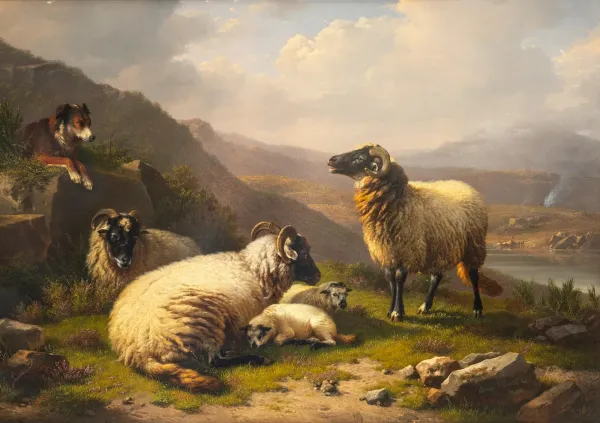
Arabs have always used fables when reality becomes too blunt to state plainly.
There is a story about a wolf teaching his cub survival. He takes him to a flock of sheep and says, “Their meat is good.” Then he points to the shepherd and warns, “His stick is painful. Do not underestimate it.”
The cub looks at the dog standing beside the sheep and says, “He looks like us.”
The father replies, “Be careful of that one. Most of the harm we have suffered did not come from the shepherd. It came from those who resembled us — but chose to stand with him.”
The shepherd’s hostility is not confusing. His stick is visible. His role is clear. It is the familiar face standing comfortably beside power that requires discernment.
Last week, the UK High Court ruled that the British government’s designation of Palestine Action as a terrorist organization was unlawful and disproportionate. The court found that banning the group constituted a serious infringement on freedom of expression and assembly. The Home Secretary, Shabana Mahmood, immediately decided to appeal the ruling and request reconsideration.
Regardless of how one feels about the group’s tactics, the ruling was a reminder of something basic: the rule of law can still restrain political overreach — when institutions choose to honor it.
But the deeper lesson is not about Britain. It is about posture under pressure. When civil liberties become politically inconvenient, who defends them? When defending Palestinian rights carries reputational risk, who recalibrates? When solidarity begins to cost something real — positions, access, funding, stability — who adjusts their language?
These are not abstract questions. They are diagnostic.
Across countries where public sympathy for Gaza runs deep, something else has unfolded. People have been punished, and sent to prison, for speech. Careers have been threatened. Voices have been narrowed.
And often, the silence has not come only from obvious adversaries. It has come from within institutions that claim to represent communal values. From officials who speak of justice in safe rooms and retreat into procedural caution when confronted publicly. From leaders who invoke identity when it is symbolic — but hesitate when principle becomes costly.
This is not betrayal in dramatic form. It is retreat in polished language. And retreat, repeated enough times, becomes collapse.
Let us stop romanticizing this. Many recalibrations are not about strategy. They are about comfort: Access to power. Protection of position. Fear of exclusion. Calculation of consequence.
So language softens. So outrage becomes “concern.” So injustice becomes “complexity.” So clarity becomes “balance.”
Every adjustment is defensible in isolation. Together, they form a pattern. And patterns tell the truth individuals try to avoid.
Power does not respect hesitation. It manages it. It does not reward surrender with dignity. It interprets it as confirmation.
Communities that defend principle — even when overmatched — signal limits. Communities that relinquish it preemptively signal pliability.
The shepherd’s stick is painful. But predictable.
The more devastating fracture occurs when those expected to articulate moral boundaries quietly redraw them. That fracture weakens resistance before confrontation even begins.
The dividing line is not religion. Not ethnicity. Not slogans. It is this: When the cost becomes personal — where do you stand? When defending civil liberties risks your position, do you defend them? When solidarity threatens access, do you moderate it. When injustice becomes controversial, do you dilute it?
History does not remember who shared names. It remembers who shared risk.
The shepherd’s stick is obvious. The deeper danger is collapsing before it is raised. And the most painful realization of all is this: Sometimes the fracture that breaks a community does not come from outside pressure.
It comes from those who look in the mirror and decide comfort is worth more than conviction.
Thanks for reading Ahmad’s Substack! Subscribe for free to receive new posts and support my work.